Module 1A: Technology, Careers, and the Future of Work
Technology, Careers, and the Future of Work
Chapter Overview
Technology shapes how people communicate, learn, solve problems, and work. For students preparing for careers in business, healthcare, engineering, computing, and many other fields, it is important to understand how digital tools are changing industries and creating new opportunities. This chapter introduces major technology trends, explores career pathways connected to those trends, and examines how computers, artificial intelligence, and data systems influence society and business.
Learning Objectives
- Explain how computers have affected society and everyday life.
- Describe how computers have transformed business operations and decision-making.
- Summarize how artificial intelligence and machine learning support business solutions.
- Differentiate between the Internet and the World Wide Web.
- Outline major developments in the history of data processing.
- Identify career fields shaped by technology and the future of work.
Key Terms
- Artificial intelligence (AI): Computer systems designed to perform tasks that normally require human intelligence, such as recognizing patterns, making predictions, or generating responses.
- Cloud computing: The delivery of computing services such as storage, software, and processing power over the Internet instead of only on a local computer.
- Cybersecurity: The practice of protecting computers, networks, programs, and data from unauthorized access, attacks, or damage.
- Data processing: The collection, organization, transformation, and analysis of data to produce useful information.
- Internet: A global network of interconnected computers and devices that exchange data and support many digital services.
- Machine learning (ML): A branch of artificial intelligence in which systems learn from data and improve their performance without being explicitly programmed for every task.
- Predictive analytics: The use of data, statistics, and algorithms to identify patterns and forecast likely future outcomes.
- User experience (UX): A person’s overall experience when interacting with a digital product, including how easy, effective, and satisfying it is to use.
- World Wide Web (WWW): A system of interlinked web pages and digital resources accessed through browsers on the Internet.
Technology and Career Opportunities
When evaluating career options, students often consider job growth, salary potential, social impact, long-term adaptability, and accessibility of the pathway. Many of today’s fastest-growing careers connect directly to computing, data, automation, and digital communication. Even careers that do not appear highly technical increasingly depend on software, information systems, and digital tools.
Artificial Intelligence and Machine Learning Specialist
- Job growth: Very strong as organizations adopt AI tools across industries.
- Salary potential: Often high in specialized or experienced roles.
- Societal impact: Supports innovation in healthcare, education, accessibility, and sustainability.
- Future relevance: Central to automation and data-driven decision-making.
- Preparation: Usually requires coursework in math, programming, and data analysis.
Cybersecurity Analyst or Engineer
- Job growth: Strong demand as digital threats continue to evolve.
- Salary potential: Often competitive across public and private sectors.
- Societal impact: Protects information, systems, and critical infrastructure.
- Future relevance: Essential in nearly every industry.
- Preparation: Entry pathways may include certifications, associate degrees, or bachelor’s programs.
Data Scientist or Data Analyst
- Job growth: High across business, government, healthcare, and technology.
- Salary potential: Strong, especially with advanced technical skills.
- Societal impact: Helps organizations make evidence-based decisions.
- Future relevance: Data literacy is increasingly important in all sectors.
- Preparation: Statistics, spreadsheets, databases, and visualization tools are common entry skills.
Healthcare Technology Specialist
- Job growth: Expanding as healthcare systems adopt digital tools.
- Salary potential: Varies by specialization, such as informatics or telehealth.
- Societal impact: Improves access, efficiency, and patient outcomes.
- Future relevance: Telemedicine, bioinformatics, and health data systems continue to grow.
- Preparation: Combines health knowledge with information technology skills.
Renewable Energy Engineer
- Job growth: Supported by sustainability goals and infrastructure change.
- Salary potential: Competitive in engineering and technical roles.
- Societal impact: Contributes directly to climate and energy solutions.
- Future relevance: Renewable energy systems depend on software, sensors, and data analysis.
- Preparation: Engineering study often includes environmental and systems thinking.
Software Developer
- Job growth: Consistently strong, especially in cloud and mobile development.
- Salary potential: Strong across many industries.
- Societal impact: Builds tools used in education, finance, health, communication, and entertainment.
- Future relevance: Software remains foundational to digital transformation.
- Preparation: Students may enter through degrees, certificates, or structured self-study.
Robotics Engineer
- Job growth: Rising in manufacturing, logistics, and healthcare settings.
- Salary potential: Often strong in specialized engineering roles.
- Societal impact: Can improve safety, efficiency, and precision.
- Future relevance: Robotics increasingly overlaps with AI and automation.
- Preparation: Often combines programming, electronics, and mechanical systems.
Mental Health Professional Using Technology Tools
- Job growth: Increasing as demand for mental health services grows.
- Salary potential: Depends on credential level and specialization.
- Societal impact: Supports well-being and access to care.
- Future relevance: Telehealth and digital support platforms continue to expand.
- Preparation: Requires discipline-specific education plus familiarity with digital care tools.
Sustainability or Environmental Scientist
- Job growth: Supported by environmental policy and sustainability initiatives.
- Salary potential: Varies by field and employer.
- Societal impact: Helps protect ecosystems and manage resources.
- Future relevance: Environmental work increasingly relies on data modeling and monitoring tools.
- Preparation: Often blends science, fieldwork, and analytics.
UX or UI Designer
- Job growth: Strong in technology, healthcare, education, and e-commerce.
- Salary potential: Competitive, especially with portfolio experience.
- Societal impact: Improves usability, accessibility, and user satisfaction.
- Future relevance: Important for websites, apps, and AI-driven interfaces.
- Preparation: Combines design thinking, accessibility awareness, and digital prototyping.
Why These Careers Matter
These career areas are appealing because they combine growth potential, meaningful work, and transferable skills. They also show that technology is not limited to one major or one profession. Students in many disciplines can build digital fluency and apply it in ways that support their own career goals.
Impact of Computers on Society
Computers have transformed society by changing how people communicate, learn, work, and access information. Personal computers, smartphones, cloud platforms, and connected devices make it possible to collaborate across long distances and retrieve information almost instantly. These advances have supported innovation in healthcare, education, transportation, finance, and entertainment. At the same time, they have introduced important challenges, including privacy concerns, cybersecurity risks, misinformation, and unequal access to technology. For that reason, digital literacy is now an essential skill for full participation in modern life.
Impact of Computers on Business
Computers have reshaped business by automating routine work, improving communication, and supporting faster decision-making. Businesses use software tools to track inventory, process payments, analyze customer data, forecast demand, and manage remote collaboration. Spreadsheets, databases, enterprise systems, and cloud platforms help organizations work more efficiently and respond more quickly to changing conditions. In today’s economy, computing supports e-commerce, marketing, logistics, customer service, and innovation.
AI and Machine Learning in Business Solutions
Artificial intelligence and machine learning help organizations move beyond simply reacting to problems. These tools can identify patterns in large data sets, automate repetitive tasks, personalize services, improve forecasting, and support decision-making. Businesses use AI and ML in areas such as pricing, fraud detection, chatbots, recommendation systems, quality control, and supply chain planning. Although these tools can improve efficiency and insight, they must be used responsibly, with attention to accuracy, bias, privacy, and transparency.
The Internet and the World Wide Web
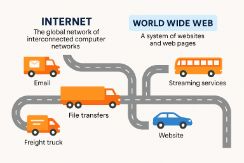
The Internet is a global network of connected computers and devices that exchange data. The World Wide Web is one service that operates on that network. The web consists of interlinked pages and resources that people access with browsers using web protocols such as HTTP and HTTPS. In simple terms, the Internet is the infrastructure, while the web is one of the services built on top of it. Other Internet services include email, file transfer, online gaming, and streaming.
A helpful analogy is to imagine the Internet as a system of roads and bridges. The World Wide Web is one type of traffic traveling on those roads. Email, file transfers, and streaming services are other types of traffic that also use the same infrastructure.
Overview of the History of Data Processing
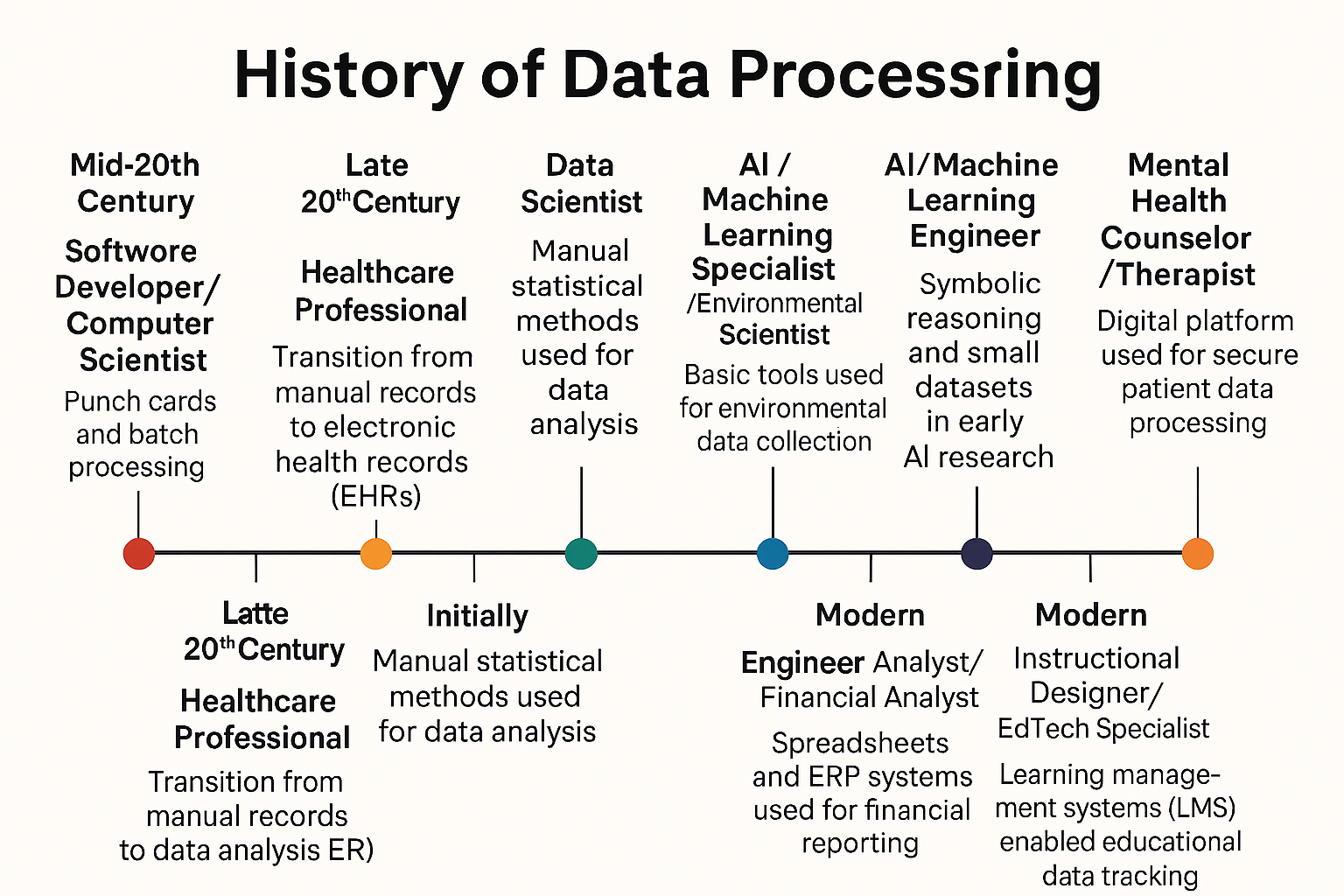
Data processing has changed dramatically over time. Early systems relied on manual calculations and paper records, which were slow and difficult to scale. Mechanical tabulators and early electronic computers increased speed and accuracy, allowing organizations to automate payroll, recordkeeping, and reporting. Mainframe systems expanded these capabilities for large institutions, while personal computers brought data tools into offices, classrooms, and homes. Today, cloud computing, artificial intelligence, and real-time analytics allow organizations to process large volumes of information quickly and use those results to guide decisions.
Chapter Summary
Technology continues to influence nearly every career field. Computers have changed society by expanding access to information and communication, while also creating new concerns about privacy, security, and equity. In business, computing tools support automation, analysis, and innovation. AI and machine learning extend these capabilities by helping organizations recognize patterns, make predictions, and personalize services. Understanding the Internet, the web, and the history of data processing provides a foundation for exploring how technology shapes the future of work.
Key Takeaways
- Technology affects both specialized technical careers and nontechnical professions.
- Computers have transformed society, business, communication, and education.
- AI and machine learning help organizations automate tasks and improve decision-making.
- The Internet is the network infrastructure; the World Wide Web is one service that uses it.
- Data processing has evolved from manual methods to real-time, cloud-based, and AI-supported systems.
Review Questions
- How have computers changed the way people live and work?
- What are two major ways computers support business operations?
- How do artificial intelligence and machine learning improve business solutions?
- What is the difference between the Internet and the World Wide Web?
- Why is it helpful to study the history of data processing when exploring modern careers?
Practice Activity
Choose one career from this chapter and research how technology is changing that field. Then write a short response that explains:
- what digital tools are commonly used in the field,
- what new skills workers need, and
- how the career may continue to change over the next ten years.
Further Reading
- Occupational Outlook Handbook for career growth, education, and pay information across occupations.
- Data Scientists Occupational Outlook Profile for an example of a technology-focused career pathway.
- CISA Cyber Hygiene Services for examples of cybersecurity practices and services.
Attribution
This educational material includes AI-generated content from ChatGPT by OpenAI and Copilot from Microsoft. The original content created by Shelley Stewart and Andy Seeley from Hillsborough College is licensed under a Creative Commons Attribution-NonCommercial 4.0 International License (CC BY-NC 4.0).
All images in this textbook generated with DALL·E and the Microsoft Copilot Image Generator are licensed under the terms provided by OpenAI and Microsoft, which allow for their free use, modification, and distribution with appropriate attribution.